CONTACT
  • Login
Upgrade
GUSTOwebzine
Advertisement
  • Home
    • Our Authors
    • Subscribe for Free
    • Media Kit
    • Contact
    • Terms and Conditions
    • Cookie Policy
  • Discoveries
    • Chefs
  • Culinary Culture
  • Food & Drinks
  • Cooking Tips
    • Recipes
  • GUSTO Global
  • Insights
  • GUSTO Guide
    • Hotels Worldwide
    • Nightlife Worlwide
    • Restaurants Worldwide
    • Services Worldwide
  • Home
    • Our Authors
    • Subscribe for Free
    • Media Kit
    • Contact
    • Terms and Conditions
    • Cookie Policy
  • Discoveries
    • Chefs
  • Culinary Culture
  • Food & Drinks
  • Cooking Tips
    • Recipes
  • GUSTO Global
  • Insights
  • GUSTO Guide
    • Hotels Worldwide
    • Nightlife Worlwide
    • Restaurants Worldwide
    • Services Worldwide
No Result
View All Result
GUSTOwebzine
No Result
View All Result
Home Hospitality Insights

Restaurant groups: quality across locations

How today's best restaurant groups protect both consistency and the local soul of each kitchen they run.

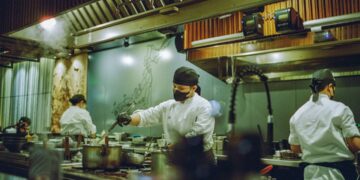
a common scene inside well-run restaurant groups focused on quality and consistency.

Restaurant groups carry a quiet obligation: the guest at table 4 in one city deserves exactly what the guest at table 4 in another city receives, yet neither room should feel like the other.

Shared standards as the operating foundation

Standardization is at the heart of scalable restaurant growth. It ensures that every guest, whether dining at the flagship or the newest location, receives the same quality of food, service, and experience. The challenge is building those standards in a way that leaves room for the kitchen’s local voice.

Standard operating procedures (SOPs) form the backbone of multi-location consistency. SOPs cover every step of food quality assurance and serve as a guide for staff, which reduces mistakes and improves accountability. Storing them in a centralized system allows easy access and updates across all locations.

GUSTO guide worldwide restaurants, hotels, nightlife, professional services GUSTO guide worldwide restaurants, hotels, nightlife, professional services GUSTO guide worldwide restaurants, hotels, nightlife, professional services

Consistency does not mean removing all decision-making from managers. Location-level leadership still needs the ability to respond to local demand and handle real-time issues. That flexibility should exist within a defined operating framework, not outside it.

Centralized training that travels well

Many restaurant groups now use cloud-based learning management systems to standardize employee training across multiple locations. These platforms allow operators to deploy consistent content, track progress, and update training in real time. A cook in Copenhagen and a cook in Cape Town can follow the same preparation logic without losing the ingredient knowledge each region demands.

A 2023 Technomic report found that 63% of top-performing restaurant chains use centralized training systems to drive consistency and growth. The most effective groups use that shared platform to teach technique, not just procedure. They separate the how from the what, so each kitchen can apply the same method to different local ingredients.

Store managers still need room to lead their teams, solve problems, and respond to local conditions. Training that builds genuine understanding rather than mechanical repetition gives them that room.

Sourcing that respects both scale and place

Smart operators maintain a core menu of standardized items while allowing limited regional variations or seasonal specials. The goal is finding the right balance between operational efficiency and local market appeal.

Buying from local farms and producers helps restaurant groups bring fresh, seasonal ingredients to the menu while building a stronger connection to the communities they serve. Many groups use local partners for produce, cheeses, meats, or other regional specialties that set their menus apart. This is where a standardized group can still feel handmade.

Regional sourcing networks ensure freshness and can reduce costs for perishable items. Rather than shipping produce from one growing region to every location, smart operators develop regional supplier relationships that deliver fresher products at lower transportation costs.

A restaurant manager inspecting fresh seasonal produce with a local supplier

Expert perspective on balancing consistency and identity

The tension between consistency and local character is real, but it is also productive. The groups that manage it well tend to separate what must never change from what must always adapt. Core technique, food safety, and service rhythm are non-negotiable. The menu, the suppliers, the visual language of the room, these can and should reflect the street outside the door. When a restaurant group treats every location as a franchise copy, guests sense it immediately. When it treats each location as a distinct expression of a shared philosophy, guests feel both trust and discovery. That combination is what builds lasting loyalty across cities, and across cultures. The operators I respect most document their standards with discipline and then give their chefs genuine creative latitude within those standards. That is not a contradiction. It is the whole point.

Industry perspective, multi-location hospitality and culinary operations professionals

Regular audits that look forward, not only back

Operational audits serve as a critical checkpoint for consistency. These structured evaluations review all aspects of performance, from food quality and cleanliness to service standards and brand adherence. The best restaurant groups use audit results not to punish locations but to share what works.


Weekly audits on food, service, and ambiance quality ensure consistent guest experiences. Store audits, checklist reviews, and operational walkthroughs confirm whether procedures are actually followed. Some problems appear in execution before they show up in reporting.

-

A chef carefully plates a fresh seafood dish as part of resort menus designed for peak coastal season guests

How Coastal Resort Restaurants Adapt Menus for August

15/08/2026
A hotel chef carefully plates a locally sourced hotel breakfast dish featuring seasonal vegetables and regional grains

Hotel breakfast and local food culture

01/08/2026
A food buyer tasting specialty food samples at a busy trade show booth in New York City

Specialty food trends from the Summer Fancy Food Show

20/07/2026
A hotel server guides a guest through an unfamiliar dish during staff training for global cuisines at a fine dining table

Best staff training for global cuisines

15/07/2026
A fine dining chef and a local farmer discuss seasonal produce reflecting a direct fine dining sourcing relationship.

Fine dining sourcing: 5 ways it works

10/07/2026
A chef carefully arranges light seasonal dishes on a rooftop dining terrace during a warm summer service

Rooftop dining menus built for summer heat

05/07/2026

Technology helps managers monitor multiple locations. Identifying areas to improve makes it easier to replicate good practice and focus on key tasks. When 1 location solves a problem well, the audit process becomes the channel that moves that solution across the whole group.

A hospitality manager reviewing performance data on a tablet during a location audit

Technology as the connective tissue

Restaurant groups need technology that enables collaboration among remote teams and simplifies management. With cloud-based platforms, groups can standardize processes across multiple locations and accelerate supply management.

Connected inventory, menu synchronization, and delivery integration are practical tools. When a menu is linked to the point-of-sale system, a seasonal item can be removed from every channel the moment it runs out. That makes it possible to respect seasonality and stop selling dishes that no longer exist.

Standardizing booking and marketing, managing reviews and permissions centrally, and sharing guest insights across locations can all happen on 1 platform while giving individual restaurants flexibility where it matters. Technology does not replace local judgment. It gives that judgment accurate, shared information to work with.

Holding quality and character together

Restaurant groups succeed when they treat consistency and local character not as competing values but as a single standard applied at 2 different scales. The techniques described here, shared SOPs, centralized training, regional sourcing, honest audits, and connected technology, give operators the structure to protect both. Restaurant groups that build this discipline find that quality rises across every location, and that the identity of each kitchen becomes stronger, not weaker, for it. If you work inside a growing group, start with your standards documentation and ask honestly whether it protects both the plate and the place. That question alone will move you forward.


Discover more about restaurant groups

  • World Restaurant Association: Global Foodservice Industry Overview
  • 2025 Restaurant Industry Outlook
  • Marketplace: Why Restaurants Opened by Hospitality Groups Are a Growing Part of the Industry
author avatar
Lars Eriksen
Lars Eriksen grew up foraging wild herbs on the Danish coast with his grandmother, long before foraging became a culinary movement. He studied gastronomy at the University of Copenhagen and has spent two decades documenting the New Nordic revolution from the inside. From Noma's legacy to the next generation of Copenhagen chefs redefining what seasonal and sustainable really means, Lars writes with the quiet authority of someone who was there from the beginning.
See Full Bio
Previous Post

How to Keep Herbs Fresh All Summer

Next Post

Ethical cocoa sourcing and the future

Related Posts

A chef carefully plates a fresh seafood dish as part of resort menus designed for peak coastal season guests
Hospitality Insights

How Coastal Resort Restaurants Adapt Menus for August

15/08/2026
A hotel chef carefully plates a locally sourced hotel breakfast dish featuring seasonal vegetables and regional grains
Hospitality Insights

Hotel breakfast and local food culture

01/08/2026
A food buyer tasting specialty food samples at a busy trade show booth in New York City
Hospitality Insights

Specialty food trends from the Summer Fancy Food Show

20/07/2026
A hotel server guides a guest through an unfamiliar dish during staff training for global cuisines at a fine dining table
Hospitality Insights

Best staff training for global cuisines

15/07/2026
A fine dining chef and a local farmer discuss seasonal produce reflecting a direct fine dining sourcing relationship.
Hospitality Insights

Fine dining sourcing: 5 ways it works

10/07/2026
Next Post
laughing woman cocoa farmer in the forest

Ethical cocoa sourcing and the future

Leave a Reply Cancel reply

Your email address will not be published. Required fields are marked *

Truelang AI Translations Truelang AI Translations Truelang AI Translations
No Result
View All Result

Our Focus

GUSTOwebzine is your international window on food culture: culinary lifestyle, trends, recipes and gastronomic stories for a global audience with a passion for exceptional taste.

Our Readers

GUSTOwebzine addresses readers who engage with food culture at a high level: as culinary professionals, passionate home cooks, food entrepreneurs, and tastemakers in their communities.

Our Approach

Recipes, trends, and dining culture are integrated as context and indicators of creativity, identity, and the social forces shaping how the world eats, not standalone content.

Recent Post

  • How Coastal Resort Restaurants Adapt Menus for August
  • Spice pantry built on India’s 6 regions

© 2026 GUSTOwebzine by NOOR & NOOR — part of WEBZINE.world.

Welcome Back!

Login to your account below

Forgotten Password?

Retrieve your password

Please enter your username or email address to reset your password.

Log In
Manage Consent
To provide the best experiences, we use technologies like cookies to store and/or access device information. Consenting to these technologies will allow us to process data such as browsing behavior or unique IDs on this site. Not consenting or withdrawing consent, may adversely affect certain features and functions.
Functional Always active
The technical storage or access is strictly necessary for the legitimate purpose of enabling the use of a specific service explicitly requested by the subscriber or user, or for the sole purpose of carrying out the transmission of a communication over an electronic communications network.
Preferences
The technical storage or access is necessary for the legitimate purpose of storing preferences that are not requested by the subscriber or user.
Statistics
The technical storage or access that is used exclusively for statistical purposes. The technical storage or access that is used exclusively for anonymous statistical purposes. Without a subpoena, voluntary compliance on the part of your Internet Service Provider, or additional records from a third party, information stored or retrieved for this purpose alone cannot usually be used to identify you.
Marketing
The technical storage or access is required to create user profiles to send advertising, or to track the user on a website or across several websites for similar marketing purposes.
  • Manage options
  • Manage services
  • Manage {vendor_count} vendors
  • Read more about these purposes
View preferences
  • {title}
  • {title}
  • {title}
No Result
View All Result
  • Home
    • Our Authors
    • Subscribe for Free
    • Media Kit
    • Contact
    • Terms and Conditions
    • Cookie Policy
  • Discoveries
    • Chefs
  • Culinary Culture
  • Food & Drinks
  • Cooking Tips
    • Recipes
  • GUSTO Global
  • Insights
  • GUSTO Guide
    • Hotels Worldwide
    • Nightlife Worlwide
    • Restaurants Worldwide
    • Services Worldwide

© 2026 GUSTOwebzine by NOOR & NOOR — part of WEBZINE.world.

Not enough quota to unlock this post
Unlock left : 0
Are you sure want to cancel subscription?
Verified by MonsterInsights
enEnglishdeDeutschesEspañolfrFrançaisitItalianoja日本語nlNederlandszh中文
No results